A rectified-flow language model that writes 1,024 tokens at a time, with no masking and no left-to-right order. Below, ReLF-Large and an autoregressive model of the same size generate side by side on measured wall-clock time.
0 ms
ReLF steps
ReLF-Large
AR-Large
Blocks
Block 1
At every sampling step all 1,024 positions hold a predicted token, and the whole block moves together along a short trajectory from noise to text; the autoregressive model fills the same block one token at a time. Each box is one token position, the clock is measured wall-clock time, and every frame is stored model output.
one block at a time, batch size 1
From the paper
Results
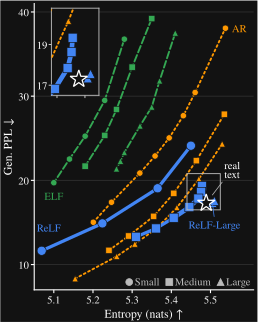
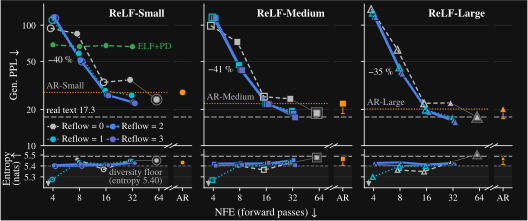
On OpenWebText with 64 function evaluations, ReLF attains lower generative perplexity than autoregressive baselines at every model size tested under matched diversity, and reflow straightens the flow for few-step generation.
(a) Quality and diversity at 64 NFE
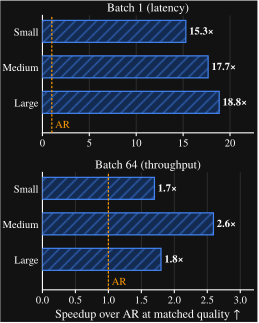
(b) Wall-clock speedup
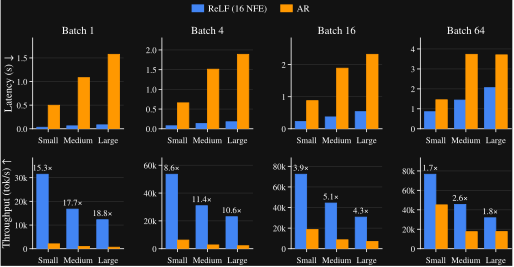
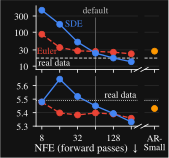
Quality, diversity and speed. (a) Quality–diversity trade-off of ReLF and ELF at 64 NFE, with AR temperature sweeps as reference; colors denote methods, markers model sizes, and the star real text. ReLF-Large reaches Gen. PPL 17.3 at entropy 5.51, close to real text (17.3 at 5.49). (b) Wall-clock speedup over AR for 1,024-token generation on one GPU, with KV caching for AR and CUDA graphs for both; ReLF after two reflow rounds at 16 NFE.Few-step generation across reflow rounds. Gen. PPL (top) and entropy (bottom) versus NFE for ReLF-Small, ReLF-Medium and ReLF-Large after zero, one and two reflow rounds. At 8 NFE, two rounds reduce Gen. PPL by 40%, 41% and 35%, respectively, relative to the model before reflow. Dotted lines are same-size AR models; long-dashed lines are real OpenWebText.Latency and throughput. ReLF at 16 NFE after two reflow rounds and AR on one GPU, with KV caching for AR and CUDA graphs for both. Top: time per batch of 1,024-token sequences; bottom: throughput in tokens per second, at batch sizes 1, 4, 16 and 64. Labels above the ReLF bars give the speedup over AR.
From the paper
Ablations
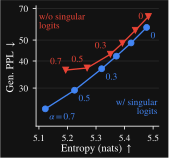
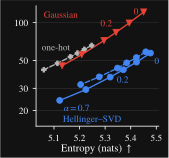
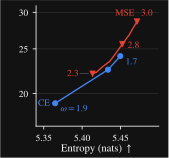
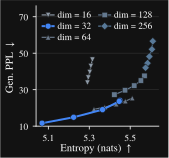
Singular logits, Hellinger–SVD embeddings and cross-entropy training each lower generative perplexity at matched entropy, and a 32-dimensional flow space gives the best quality–diversity trade-off.
(a) Singular logits
(b) Embedding matrix
(c) Training objective
(d) Flow embedding dimension
(e) Sampling budget
(f) Guidance and model size
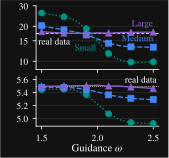
Ablations. ReLF-Small at 64 NFE unless indicated. (a) Singular logits under momentum guidance α. (b) Embedding matrix. (c) Cross-entropy and MSE training objectives over the guidance scale ω. (d) Flow embedding dimension. (e) Number of function evaluations at ω = 1.7. (f) Guidance response of the Small, Medium and Large models. Panels (a)–(d) show Gen. PPL versus entropy; (e) and (f) show Gen. PPL above and entropy below. The diversity floor is entropy 5.40. At entropy 5.45, cross-entropy training reaches Gen. PPL 24.1 versus 25.6 for MSE.
From the paper
How it works
ReLF is trained with cross-entropy on positionwise token posteriors, and its velocity is the posterior-weighted mean of the token embeddings. Singular logits capture the divergent part of the posterior analytically, leaving the network a bounded residual and guaranteeing that the flow converges to a valid token embedding.
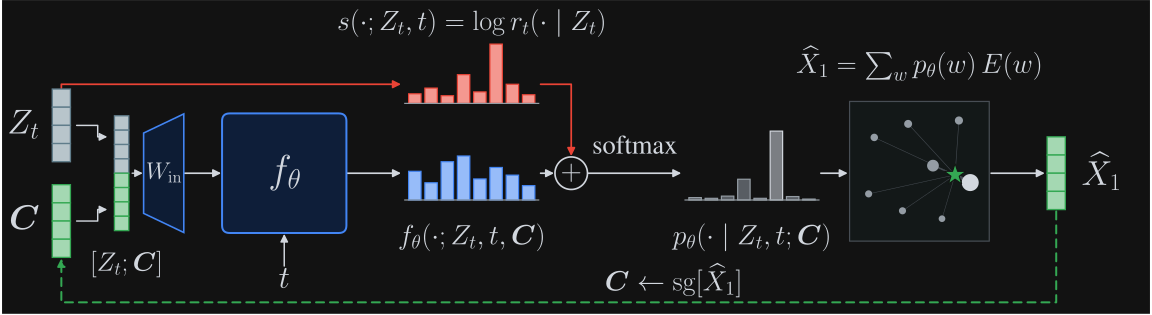
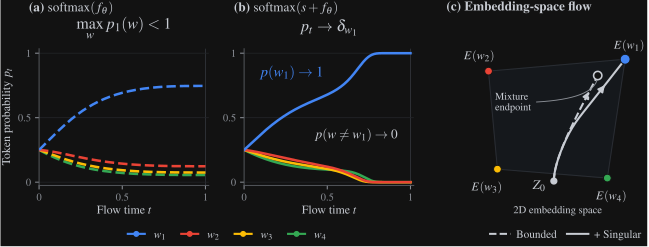
Architecture. From the noisy state Zt and the self-conditioning input, the Transformer outputs residual logits fθ, which are added to the singular logits s. The prediction X̂1, a probability-weighted mean of token embeddings, is fed back without gradient as the next self-conditioning input (dashed).Singular logits connect commitment to embedding convergence. A four-token example in which both models share the bounded residual fθ and the initial state Z0. (a) With bounded logits, the token distribution pt keeps mass on competing tokens. (b) Adding s = log rt drives pt to a one-hot distribution. (c) Correspondingly, the flow ends at an embedding mixture (dashed) or at the token embedding E(w1) (solid).
About the replay
Model
Sequential steps per block
Time per block
Speedup, batch size 1
Speedup, batch size 64
Gen. PPL
Entropy
Time per block is the median wall-clock time over 8 runs to generate one 1,024-token sequence on one GPU at batch size 1, after warm-up; runs differ by less than 0.4%. AR-Large uses KV caching and a compiled decoding step, and both models run as CUDA graphs. Speedup is AR time divided by ReLF time for a batch of 1,024-token sequences.
The advantage is in latency. At batch size 64 the autoregressive model uses the GPU more fully, and the ratio falls as the table shows.
Each box is one of the 1,024 token positions of a block, in reading order; ↵ is a newline token and <eos> the end-of-text token that separates documents. A token too long for its box is set smaller.
The ReLF frames are stored trajectories of the checkpoint and sampler that were timed. At every sampling step the network outputs a distribution over the vocabulary for each position; a box shows the most likely token of that distribution at that step, and a box lights up when its token changes. Before the first step the state is Gaussian noise and nothing is decoded. The 64-step setting is the stochastic sampler of the paper's main results; it injects fresh noise at every step, so its prediction keeps changing until the last step. The 16- and 32-step settings use the deterministic Euler sampler, whose prediction settles step by step.
Gen. PPL (under GPT-2 Large, lower is better) and unigram entropy are measured over 1,024 samples of the same checkpoint and sampler. Lowering the temperature lowers both for the autoregressive model, so compare rows at similar entropy. The 16- and 32-step rows are the model before reflow, which is what the replay shows; after two rounds of reflow the paper reports Gen. PPL 19.4 at entropy 5.41 for 16 steps and 16.2 at 5.43 for 32 steps, at the same time per step.
The AR-Large block is a stored evaluation sample at temperature 0.98; its first token is given and the other 1,023 are generated. Samples of both models were taken in stored order, skipping those with offensive or violent content.
 Rectified Language Flow